
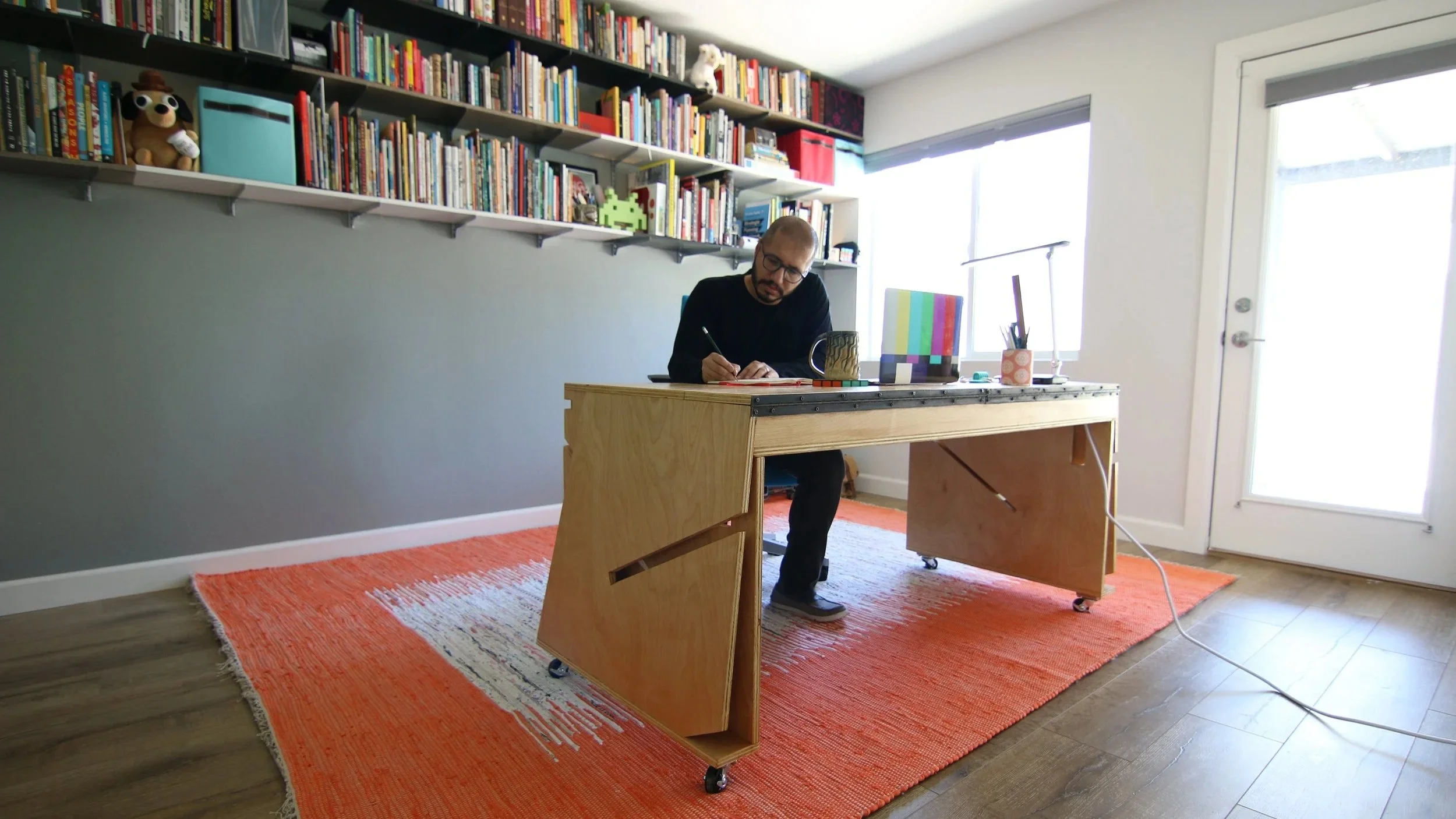
Bio
Safwat Saleem’s work grows out of his life as an immigrant father raising multiracial children in the American Southwest. Drawing from private material, family archives, language lessons, parental anxieties, voicemails saved for decades, and nineteen years inside the U.S. immigration system, he works across video, sound, installation, and design to build immersive systems that mirror the bureaucracies shaping immigrant life.
His most recent work The Unrequited Love Institute (T.U.L.I.), placed thousands of visitors inside a fictional government agency evaluating who belongs in America. It was presented as a solo exhibition at the Phoenix Art Museum.
He is a Senior TED Fellow, and recipient of the Scult Mid-Career Award (2024), the Charles Clements Award at the Arizona Biennial (2024), the Define American Fellowship (2023), and the AAPI Creative Catalyst Fellowship (2023). His work has been exhibited at the Phoenix Art Museum, Tucson Museum of Art, Wing Luke Museum, El Paso Museum of Art, and others.
He lives and works in Phoenix, Arizona, and still gets asked where that accent is from.
Artist statement
My work is about what it feels like to be wanted and unwelcome at the same time.
I make work from personal material, family letters, voicemails, language lessons, parental anxieties, and expand it into immersive systems that mirror the bureaucracies shaping immigrant life. I use satire and institutional mimicry to investigate cultural loss, assimilation, masculinity, and conditional citizenship.
I spent nineteen years navigating the U.S. immigration system. My mother speaks to me in Punjabi. I respond in Urdu. My daughter answers in English. In my family, language shifts within a single generation. I am trying to hold onto what I can before it disappears entirely. That urgency is where the work comes from.
More recently my practice has shifted toward large-scale world-building. The Unrequited Love Institute (T.U.L.I.) is a multi-room installation that places visitors inside a fictional agency evaluating who belongs in America. Orientation videos, case files, cubicles, and motivational posters mirror the aesthetics of bureaucratic neutrality while exposing what those aesthetics normalize.
This work resists disappearance. I also know it's part of the deal. Languages get lost. Names change. That is how migration works. This work lives inside that tension and doesn't try to resolve it.